Welcome

Thank you for stopping by. Strawberry Monde is a smorgasboard of all the things I find interesting, ranging from current events to pop culture to fashion to food and entertainment. I hope you enjoy your visit!
Showing posts with label science. Show all posts

See Jane Speak


When I was a girl, Jane Goodall came to my school to speak about her work with primates. I was 8 years old and it was the first time I had ever encountered a famous, distinguished person (other than a chance Blazer sighting in Portland). Generally, those guest speaker talks in school are often more for the parents who plan them than for the children, but this was a great exception.

I remember being captivated by Jane's stories, told in her beautiful speaking voice, with her London accent, which back then sounded not only sophisticated, but exotic too. She told us stories about her research in Tanzania, and about David Greybeard, the first chimpanzee she observed using tools and the importance of conserving the natural habitat of the animals.
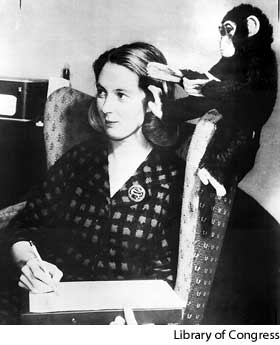
This morning I watched her Ted Talk from 2007 on what separates us from the apes. It brought me back to that day all those years ago when I saw her speak for the first time. I was struck by how little she has changed and how engaging her quiet style is. I also found these pictures of her as a young woman and I love how chic she looks, whether standing in the jungle or having a chimp brush her hair. I wonder what it would have been like to be a young woman in the 1950's setting off for Tanzania to study with Louis Leakey. You can watch the Ted talk below:

Temple Grandin

Last year I discovered Temple Grandin. She is an author, doctor of animal science at Colorado State University and she is autistic. Her remarkable story was made into an HBO movie starring Claire Danes (I highly recommend it). She grew up in the 1950s at a time when Autism was barely even known and as a result of the devotion of her mother and teachers, she was able to harness her genius and become one of the most renowned livestock experts in the world.

She's written numerous books, two of which I am currently reading Animals Make us Human and Thinking in Pictures. The latter is her memoir about growing up with Autism. In 2009 she did an interview with Terry Gross, you can listen to it here. I am equally fascinated and awed by Temple Grandin's story. Her insight has been invaluable to understanding the thought processes of Autistic children. Give the TED talk or her interview a listen and I guarantee you will come away inspired and entertained, not to mention a little smarter.

The Future Has Arrived

Awesome.

What I'm reading


I received How we Decide by Jonah Lehrer as a birthday gift a couple of months ago and I've finally started to read it. The book explores what happens in our brain when we make decisions and why some of us make better decisions, or make them more easily than others. This book is to brain science what Freakonomics is to economics. It's approachable and fascinating.I heard Lehrer do an interview on NPR a few months back in which he explained his inspiration for the book:
The revelation occurred in the cereal aisle of the supermarket. I was sent to the supermarket with what seemed like simple instructions, which was buy a box of Cheerios. And it wasn't until I got the supermarket that I realized that there were 20 different kinds of Cheerios. There were original Cheerios. There were honey-nut Cheerios, apple-cinnamon, multigrain, the yogurt-with-the-berry thing, and then of course there are all the generic varieties of Cheerios.

Lehrer went on to describe how it took him over 30 minutes of deliberation in the supermarket to decide on some cheerios. He describes himself as "pathologically indecisive." We all know people that suffer from the "paralysis of analysis" (some of us are people like this) and I've never read anything quite like this.

I am less than halfway through the book and it is blowing my mind. One of the most compelling things that research has shown about decision making is that emotions are a positive component to our ability to make decision. This is evidenced by victims of brain damage, specifically those who have damaged the part of their brain that exhibits emotions. They don't associate feelings with good or bad choices, so they often make strictly rational decisions, which often have negative consequences. Lehrer asserts that without the emotional sting of failure attached to their decisions, success becomes impossible.

The best part about reading a book about behavior or the brain is that we often receive scientific evidence or confirmation that our instincts were correct. Think of all the little sayings we have about failure building one's character and making success all the sweeter. Turns our there is a dopamine explanation for all of that. Gotta love a little brain science.